A two-dimensional figure is not necessarily flat. It can possess its own internal structure. An example of this is the Sierpinski triangle — a figure whose area disappears through the process of construction. The emerging voids are not “nothing”; they become structural elements that hold the form together.
The Sierpinski triangle is a fractal — a self-similar structure in which the number of voids tends toward infinity.
Making a brief digression, it is worth noting that fractal logic surrounds us everywhere: natural forms are constructed according to this very principle. However, I will not develop this topic in the present article, keeping the focus on observing the formation of a “bridge” between dimensions.
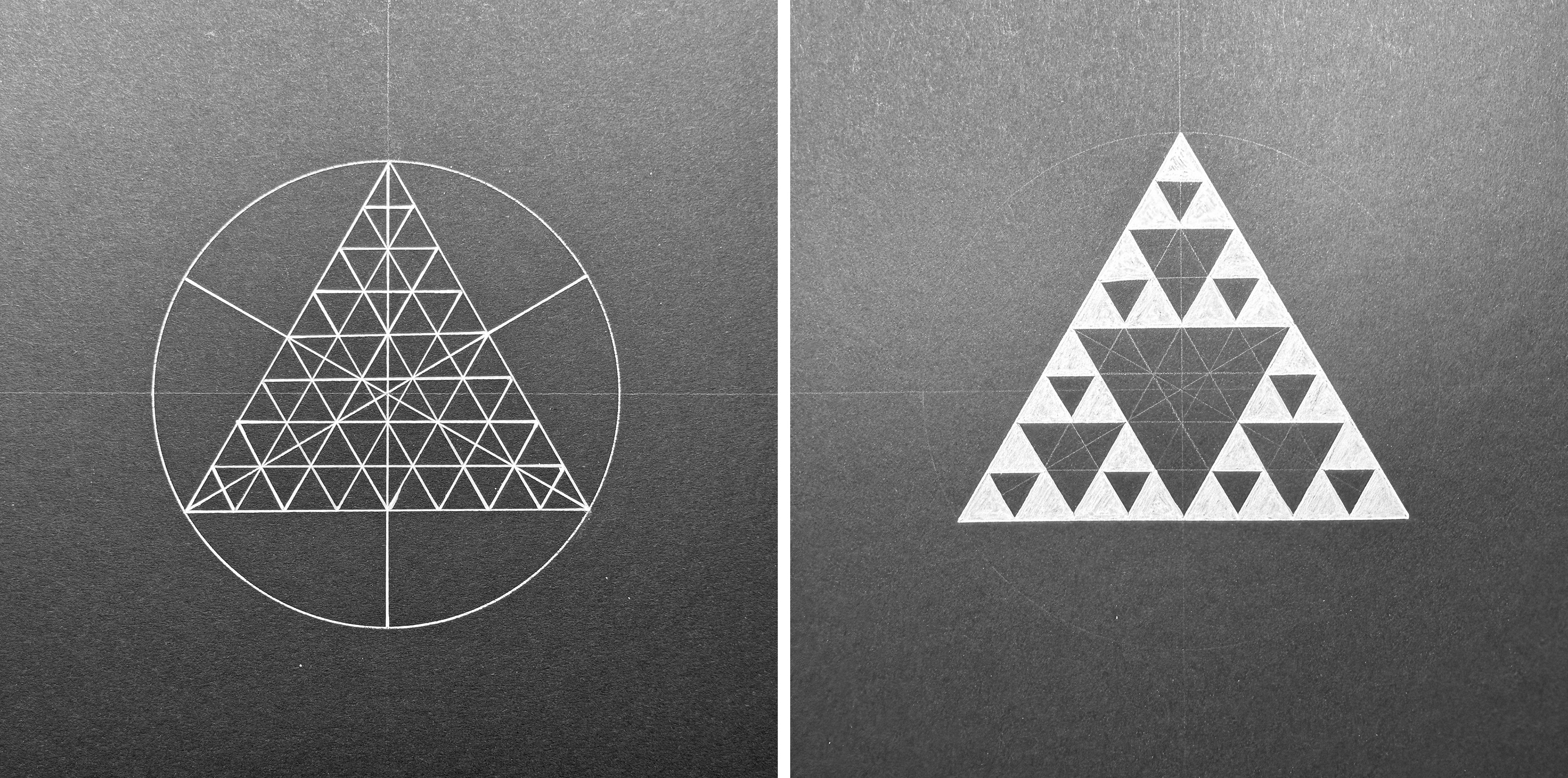
Construction process shown step by step:
Thus, we observe the following:
• the outline remains two-dimensional;
• at the same time, the area tends toward zero.
This means that what we see is no longer simply a flat figure, but a boundary state in which new properties emerge — properties that go beyond the usual understanding of two-dimensionality.
Knowing that flat forms often function as projections of volumetric ones, let us turn to the Sierpinski pyramid.
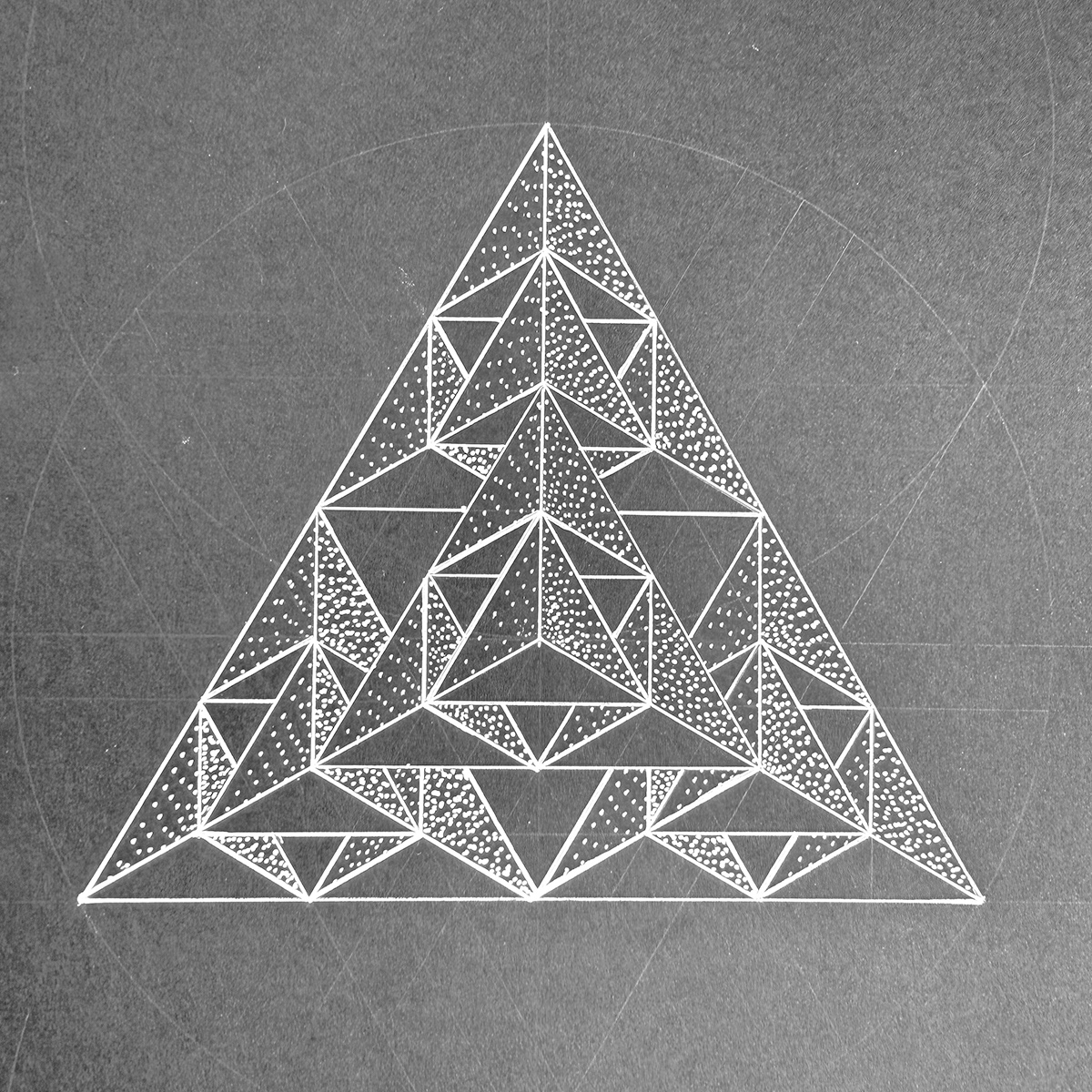
Here, volume appears — yet it also tends toward zero. Void ceases to be merely external; it becomes an internal component of the structure.
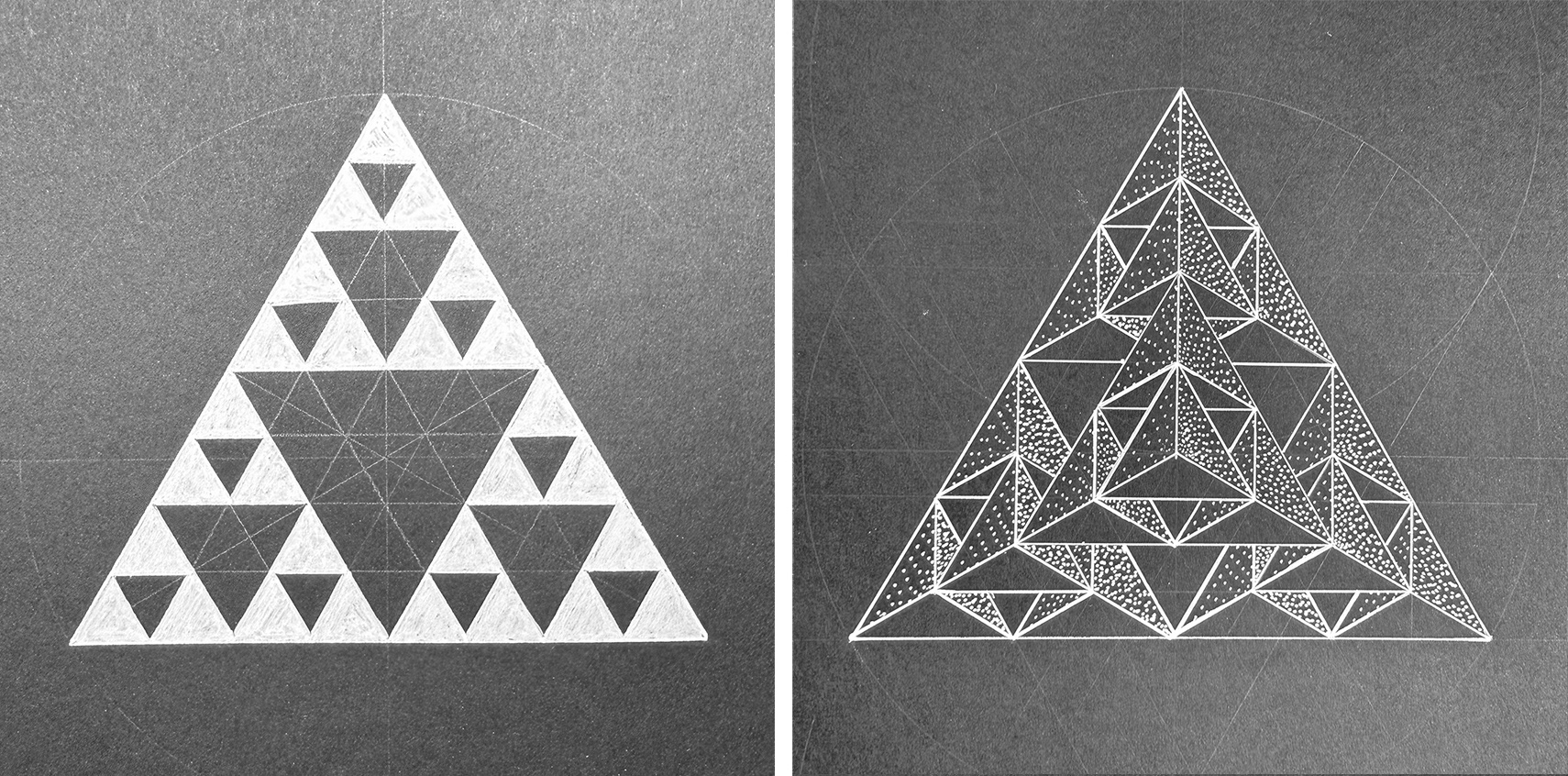
These two forms are united by a single logic: void, which transforms surface into space by granting the form new properties; and repetition, which holds the structure together. It is precisely this combination that disrupts strict boundaries between dimensions and creates the foundation for a transition into new spatial projections.
I began my exploration of the triangle with the construction of a triangular grid. The idea is that the triangle is a fundamental form in two-dimensional space: the first plane, the first closed shape capable of independently filling space and expanding it. The grid formed by equilateral triangles — the isometric grid — lies at the foundation of most geometric ornaments and structures.
It is important to note the following: isometric projection is a type of axonometric projection and is used in technical drawing to represent three-dimensional objects on a plane. This fact resonates strongly with me, as it marks a transition from the flat to the volumetric, when a two-dimensional structure begins to think spatially.
At this point, I return to the tetrahedron — a solid directly associated with the triangle. Its faces are equilateral triangles, and it serves as a fundamental form of three-dimensional space. At the same time, the tetrahedron introduces a different logic — the logic of four: four faces, four vertices, the minimal stable volume.
With this gesture — recalling three-dimensionality — I bring us back once again into two-dimensional space, but now with a new optic. The logic of four finds its graphic expression in the square — a form that completes this transition while simultaneously opening the next stage of exploration.
PREVIOUS ARTICLE | NEXT ARTICLE
This blog is a personal reference system for geometry, symbolism, and practice.